Hi, I'm Guy Spier
Welcome to my personal online home.
For 28 years, I ran the Aquamarine Fund, an investment partnership closely modeled on the original Buffett Partnerships, for a group of families including my own. Over that period, I delivered a 13x return—marginally beating the S&P 500—and concluded my tenure for outside investors with $470 million in assets under management.
Following a glioblastoma (GBM) diagnosis in late 2024 and its recurrence in 2025, I have returned outside capital, and Aquamarine is now a "family office". I wrote about this decision and the lessons I have learned along the way in my 2025 Management's Letter to Partners. If you want to understand where I am, that letter is the place to start. To date, it has been downloaded more than 10,000 times, and was featured in Barron's by Andy Serwer here and in Bloomberg by Levin Stamm here.
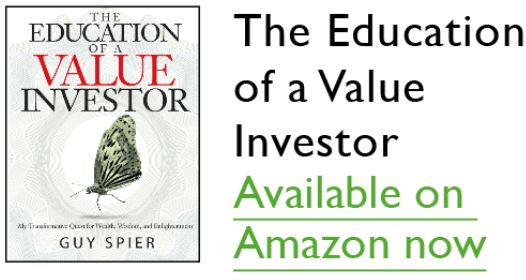
I am the author of "The Education of a Value Investor", which has now sold more than 175,000 copies in English and has been translated into Spanish, German, Japanese, Korean, Chinese, Polish, Hebrew, and Vietnamese.
I host an annual investment gathering called VALUEx in Klosters, Switzerland, and VALUExBRK at the Berkshire Hathaway meeting.
I used to be on a quest for wealth, wisdom, and enlightenment. I am now on a quest for health, wisdom, and enlightenment—with wealth in fourth place, if at all.
Health
I am interested in all things health—and in brain health in particular. My focus is on glioblastoma and related fields, including new and potential therapies such as CAR-T, personalized vaccines, and other emerging approaches.
I am also interested in the companies working to advance the field. Among those I follow are Cellula Therapeutics, CeGaT, Nanotics, and Trogenix.
I have chosen to be open about my diagnosis because openness may increase the odds that useful ideas, people, or research find their way to the right place.
Getting in touch
If you want to send medical suggestions or GBM-related investment opportunities, please route them through my wife Lory or my assistant Chantal.
- VALUEx or VALUExBRK: You need to be connected with and known to current members of the community.
- Investment ideas: Still very much of interest. A good idea can come from anywhere, and I appreciate your thinking of me. Please write the idea up first—it does not need to be long or extensive, but it needs to be something I can read and evaluate.
- Mentorship, job, or career conversations: I love helping hard-working, smart people but there is a limit to my bandwidth, and there are only so many inbound messages my staff and I can respond to. Please first read this piece by Patrick McKenzie. I am most likely to respond if you demonstrate that you can express worthwhile and interesting thoughts clearly and concisely—in writing. One way to start: Look at the books I have been reading and write a review or thought piece on one.
- Investing with me: I am no longer managing outside capital.
The best way to send me a message is via LinkedIn or X: You can find my email in Linktree.
My now(s)
Podcast, YouTube channel, email newsletter
I continue to host a podcast and a YouTube channel. My goal with the podcast is not so much to create a show as to use the medium as a way of learning in public. You can listen here:
I also maintain a semi-annual email newsletter with more than 30,000 subscribers, covering my current thoughts as well as other content—much of it original. You can subscribe here. If you would like to write an original piece or white paper for the newsletter, let me know.
Investment interests
Even though I no longer manage outside capital, I have not stopped being an investor. I remain especially interested in durable, time-friendly compounders—businesses where time is an ally and the range of long-term outcomes runs from decent to superb, with a low chance of permanent loss.
Areas that continue to interest me include:
- Luxury goods and brands with deep emotional moats
- Credit ratings and the infrastructure of trust
- Elevators and other mission-critical industrials
- Stock exchanges and market infrastructure
- Aircraft and aero engines
- Payment networks and the plumbing of global commerce
If you think you can teach me something in any of these areas, send me a thoughtful note or memo. I check LinkedIn and Twitter regularly, and so do my staff.
People I've been learning from
In addition to investors I like to learn from.
- David Deutsch: physicist, father of quantum computing, identifier of "the pattern"
- Avi Loeb Scientist with unmatched curiosity, on a search for extraterrestrial life
- Christopher Bloomstran
- Patrick Collison
- Patrick McKenzie
- Ashkan Nikeghbali
- David Perell
- Naval Ravikant
- Niall Ferguson
- John Mihaljevic
- Tiago Forte
- Shu Omi
- Jason Zweig
- Diane Coyle
- Jordan Peterson
- James Currier: My guru on network effects
- Anne-Laure Le Cunff: my guru on Roam Research and digital gardens
- Syed Balkhi: My all-round guru on WordPress, blogs, the internet, and more
- Kiana Aran
- Robert Leitz
- Sam Altman
- Luca Dellanna
Scuttlebutt
I continue to explore how to use social media for better investment research—especially for scuttlebutt. The tools I experiment with include X, LinkedIn, Instagram, email, expert networks, and podcasts.
Knowledge management
Much of the above spills into personal knowledge management, where I've been a fan of:
- David Perell and his writing course
- Tiago Forte and Building a Second Brain
- Anne-Laure Le Cunff and Ness Labs
- Soenke Ahrens and the Zettelkasten system
Roam Research is a regular companion. I also use Evernote, keep many Moleskine notebooks for fleeting notes, and have started using Zotero and Glasp.
Books
I published a list of useful books in the bibliography of my own book. That was some years ago.
I used to order almost every book that looked interesting, and so I have a large anti-library. Soenke Ahrens and others have switched me on to the danger of the collector's trap: Collecting containers of knowledge without processing them. Today I try to make notes on a book first, and why it might make sense to read it, before ordering it. My library is like a cocktail party: Not everyone merits a long and deep friendship but many are vital conversation starters.
The list below is not complete or in order—it's a conversation starter. Writing to me about any book on it is a good way to connect. Much of my physical collection is catalogued on LibraryThing. I also read a lot on the Kindle, reflected in my GoodReads account.
- Stalin: The Court of the Red Tsar by Simon Sebag Montefiore
- Stalin: Paradoxes of Power, 1878–1928 by Stephen Kotkin
- Chokepoints: American Power in the Age of Economic Warfare by Edward Fishman
- The Lily of the Field and the Bird of the Air by Søren Kierkegaard
- Don Quixote by Miguel de Cervantes
- Janeway's Immunobiology by Kenneth Murphy and Casey Weaver
- Molecular Biology of the Cell by Bruce Alberts et al.
- How to Be a Friend to a Friend Who's Sick by Letty Cottin Pogrebin
- An Introduction to Gestalt by Charlotte Sills, Phil Lapworth, and Billy Desmond
- Uncertainty and Enterprise: Venturing Beyond the Known by Amar Bhide
- Rethinking Narcissism by Dr. Craig Malkin
- In the Shadow of the Sword by Tom Holland
- The Bell by Iris Murdoch
- Waverunner by Suzanne Heywood
- Die Red Bull Story by Wolfgang Fürweger
- What I Learned about Investing from Darwin by Pulak Prasad
- The Parasitic Mind by Gad Saad
- People Love Dead Jews by Dara Horn
- The Perfect Weapon by David E. Sanger
- Power: Why Some People Have It—and Others Don't by Jeffrey Pfeffer
- Who by Fire by Matti Friedman
- Lie Machines by Philip N. Howard
- The Dying Animal by Philip Roth
- Chip War by Chris Miller
- Le Rouge et le Noir by Stendhal
- How the World Really Works by Vaclav Smil
- A Concise Introduction to Pure Mathematics by Martin Liebeck
- The $12 Million Stuffed Shark by Don Thompson
- The Curious Economics of Luxury Fashion by Don Thompson
- Who Is Michael Ovitz? by Michael Ovitz
- Freezing Order by Bill Browder
- Nothing Is True and Everything Is Possible by Peter Pomerantsev
- The History of the Peloponnesian War by Thucydides
- The Shortest History of Germany by James Hawes
- Why Mahler? by Norman Lebrecht
- David Copperfield by Charles Dickens
- Capitalism and the Jews by Jerry Z. Muller
- Richer, Wiser, Happier by William Green
- The Stuff of Thought by Steven Pinker
- Tribe of Mentors by Tim Ferriss
- Swiss Made by James Breiding
- 12 Rules for Life by Jordan Peterson
- Chimpanzee Politics by Frans de Waal
- 100 Baggers by Chris Mayer
- Lee Kuan Yew: The Grand Master's Insights
- Just Hierarchy by Bell and Wang
- Pandemic 1918 by Catharine Arnold
- 7 Powers by Hamilton Helmer
- Essays by George Orwell
- No Rules Rules by Reed Hastings and Erin Meyer
Leisure and family
When I'm not working or reading, I love spending time with my family and moving my body. Movement is, for me, a form of medicine: walking, cross-country skiing, and the rowing machine are regulars, along with cycling, swimming, running, rowing, and tennis in the warmer months, and various kinds of snow and ice sports in winter. Klosters remains a happy place. You can follow me on Strava.
I like playing chess—badly; my rating has been hovering just below 1,000. You can find me on Chess.com.
If we are not already connected, the best way to be in touch is via X or LinkedIn or check my Linktree.
Hineni. Here I am. I don't know what comes next, but I am here to meet it.